

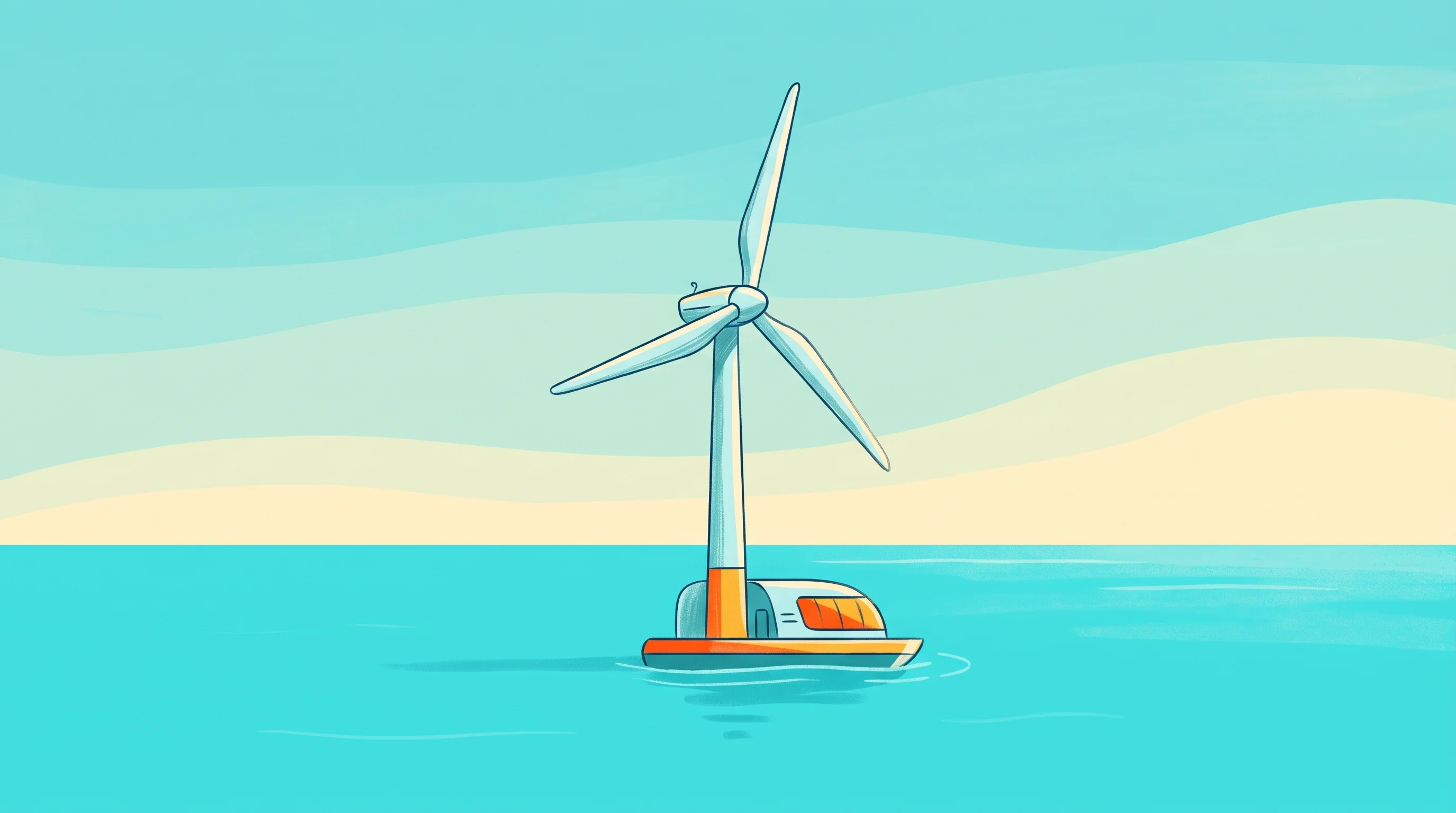
Aikido Technologies, a San Francisco startup in Y Combinator's Fall 2026 batch, plans to house AI computing inside floating offshore wind platforms, each carrying more than 10 megawatts of data halls cooled through the surrounding sea via closed-loop freshwater circuits. The company is aiming for a 100-kilowatt demonstration in the North Sea by the end of 2026, and said in a March 3, 2026 announcement that its first commercial site is targeted for the United Kingdom in 2028.
The pitch is aimed at power rather than chips, which the company frames as the real bottleneck for AI growth.
What Aikido Is Building
The AO60DC unit is designed to host 10 to 12 MW of AI compute alongside a turbine of 15 to 18 MW or more, according to the March 3 press release. Data Center Dynamics (DCD) reported that the design uses three prefabricated data halls of 3 to 4 MW each. IEEE Spectrum, in May, said each hall sits inside a ballast tank.
Aikido expects a power usage effectiveness, the ratio of total facility energy to the energy that reaches the computers, below 1.08. Anything near 1.0 is considered very efficient. Per the release, cooling runs through closed-loop freshwater circuits that pass heat through the steel hull into the surrounding sea, so no seawater enters the IT loop. The company said the resulting thermal plume would be limited to a few meters.
Batteries of four hours or more would cover most operating hours, with grid power used mainly in summer, the company said. DCD reported the batteries would be pre-charged ahead of expected grid stress.
Aikido also says it can reach customers within 10 milliseconds round-trip across 200 miles. That is a marketing claim, though a CommScope latency whitepaper puts fiber propagation near 5 microseconds per kilometer, which makes the figure plausible if routing overhead stays modest.
Why Offshore, and Why Now

The demand case rests on very large forecasts. The IEA said hyperscalers, the biggest cloud and AI operators, are set to spend more than $700 billion in capital expenditure in 2026. Goldman Sachs expects global data-center power demand to rise about 170% between 2025 and 2030, with more than 60% of the growth coming from the U.S., according to Axios.
McKinsey said roughly 75% of anticipated U.S. power demand growth over the next decade comes from data centers. It also cited 4 GW of projects postponed in the first quarter of 2026 because of community action. Tom's Hardware reported that on Oct. 23, 2026, Amazon scrapped four planned AI data centers in Northern Virginia after local backlash.
Aikido's argument is that open water sidesteps both the interconnection queue, the long wait for a grid hookup, and the neighbors. "We have this power from the wind. We have free cooling," CEO Sam Kanner told IEEE Spectrum in May.
Cooling itself is changing. TrendForce expects liquid-cooling penetration in high-end AI infrastructure to reach about 53% in 2026, and Dell'Oro projects the liquid-cooling market will approach $7 billion by 2029.
The Team and Its Backers
Kanner holds a PhD in mechanical engineering from UC Berkeley and was head of R&D at floating-wind developer Principle Power, per the company's YC page. Co-founder Bingbin Yu, chief engineer for platforms, was Principle Power's head of hydrodynamics analysis. James Reeves, the other co-founder and chief engineer for wind turbines, has an aerospace background that includes helicopter design.
The YC directory lists a team of five and a 2022 founding date. Aikido announced a $4 million seed round in June 2024, led by Azolla Ventures, with Propeller Ventures, Sabancı Climate Ventures, Cisco Foundation and Anthropocene Ventures participating. It has also been selected for NVIDIA's Inception program. No new round turned up in the research reviewed for this article.
On engineering validation, the American Bureau of Shipping issued a statement of maturity in February 2025 after witnessing the upending of Aikido One, a 1:4-scale platform. The company said that platform was assembled in under a week.
A Crowded, Cautionary Field
Aikido is not alone in taking compute offshore. DCD, citing reports, said China's HiCloud has a 24 MW wind-powered underwater data center in operation off Shanghai, at a reported cost of about $226 million with 2,000 servers. English-language primary documentation is limited, so the details deserve some caution.
Panthalassa, a Peter Thiel-backed U.S. startup building wave-powered floating AI nodes, had $140 million in funding reported in May and June 2026, according to ITPro. Its Ocean-3 test is slated for later in 2026.
Older attempts offer less encouraging precedent. Microsoft's Project Natick ran from 2015 to 2020 and was never commercialized. Nautilus Data Technologies commissioned a barge-mounted data center at Stockton in December 2020, and the site was marketed for sale in 2024.
Seawater cooling on land is better established. Google's Hamina campus in Finland has used Baltic seawater for years, and in September 2026 the company announced a €13 billion Finland investment.
Regulatory and Security Questions
Not everyone is uncritical. Daniel King of the Foundation for American Innovation cautioned IEEE Spectrum about environmental review and subsea security risks. Investor Ramez Naam was more generous, saying, "Aikido has [power, cooling, and siting], and a smart team."
Regulators will gate every site. In the U.S., Clean Water Act permits cover thermal discharges, and a presidential memorandum paused new offshore wind leasing in January 2025, which complicates domestic plays.
Europe is moving the other way. Ten nations signed the Hamburg Declaration on Jan. 28, 2026, to coordinate 100 GW of North Sea offshore wind.
What Remains Unproven
The proof is still pending. Company pages describe a summer 2026 retrofit of a small turbine and proof-of-concept data center on Aikido One. As of Oct. 28, 2026, the research found no independent confirmation that an at-sea computing demo had gone live, which leaves the end-of-year target looking tight.
Scale is another open question. RenewableUK data shows floating wind operational capacity at about 382 MW by October 2026, up 38% year on year, so a single 15 MW Aikido unit would be sizable against that base.
The company's 2025 agreement with Norway's METCentre pointed to a 15 MW AO60 demo in 2027. Beyond that, its sights are on the 2028 UK site.


