

Cosmic Robotics, a Y Combinator-backed startup that builds robots to lift and place solar panels, has secured $25 million in contracts through 2027, TechCrunch reported on September 13, 2026. The number reflects contract value rather than recognized revenue, and it comes from the company itself.
The machines are already working on utility-scale sites in California, Texas and along the East Coast, according to Engineering News-Record's August 2026 reporting. Asked in a Y Combinator Demo Day interview about its largest deal, the company described a major construction-company contract but declined to name the customer.
What the robot actually does
Think of it as a very precise pair of hands rather than a crew. The system handles navigation, lifting and placement inside a construction workflow still run by people. It does not build a solar farm on its own.
CEO James Emerick drew that line himself in ENR. "It can do the lifting and placement, but we have people around to do the fastening and fine adjustments," he said. A KUKA case study describes autonomous fastening as future development.
Accuracy figures differ by source. KUKA's case study cites ±1 mm, while ENR's August 2026 article says within 2 mm. Neither disclosed the test conditions behind its number, so the gap is hard to interpret.
Speed is murkier still. TechCrunch reported in April 2025 that the robot placed one panel every 30 to 40 seconds, but that is more than 18 months old and should not be read as a current specification.
Customers and field results

On February 3, 2026, SunRobi announced it had become Cosmic's first Certified Operator after multiple live U.S. project deployments. The release left out project names, deployed megawatts, robot counts and contract values.
"This isn't an experiment anymore. It's ready for production today," said Helge Biernath, CEO of Sunstall Inc., in that announcement.
A KUKA case study quotes Philipp Kauls, a project manager at Sunstall, who said robotic lifting allowed a smaller crew to maintain or improve production compared with an earlier five-person workflow. "Having the robot handle that part of the process takes a huge burden off our crews," he said. Both endorsements come from partners with a commercial stake in the technology, which is worth bearing in mind.
Founders and funding
Emerick has said he grew up around his grandfather's construction sites. According to YC's profile and the Demo Day interview, he spent four years deploying autonomous bulldozers and excavators before noticing manual tasks that lacked suitable equipment. Co-founder and CTO Lewis Jones is listed as principal investigator on NASA's Cosmic-XT proposal. YC's profile lists eight team members, though the page is undated.
Axios reported on April 17, 2025 a $4 million pre-seed round led by Giant Ventures, with HCVC and MaC Ventures participating. SEED Innovations disclosed a $350,000 SAFE (a simple agreement for future equity) on July 16, 2026, uncapped and undiscounted. Together, the two private financings total $4.35 million by simple arithmetic. That excludes YC's investment, which was not disclosed.
Cosmic also holds a $149,521 NASA SBIR Phase I award for Cosmic-XT research. That is government research funding, not equity. Pricing is not public; the company's website directs visitors to a "Request a Quote" page.
Awards and a Mars ambition
Cosmic won BuiltWorlds' Construction Tech Demo Day, with Jones presenting, the organizer said on July 22, 2026. Google named the company to its AI-for-Energy accelerator cohort on August 26, 2026, and a Google post lists a November 11, 2026 presentation date.
On August 19, 2026, the founders published an essay titled "Building a City on Mars." "Our mission at Cosmic Robotics is to build a city on Mars," they wrote. The materials reviewed show no launch contract, Mars demonstration or Mars customer.
A crowded field
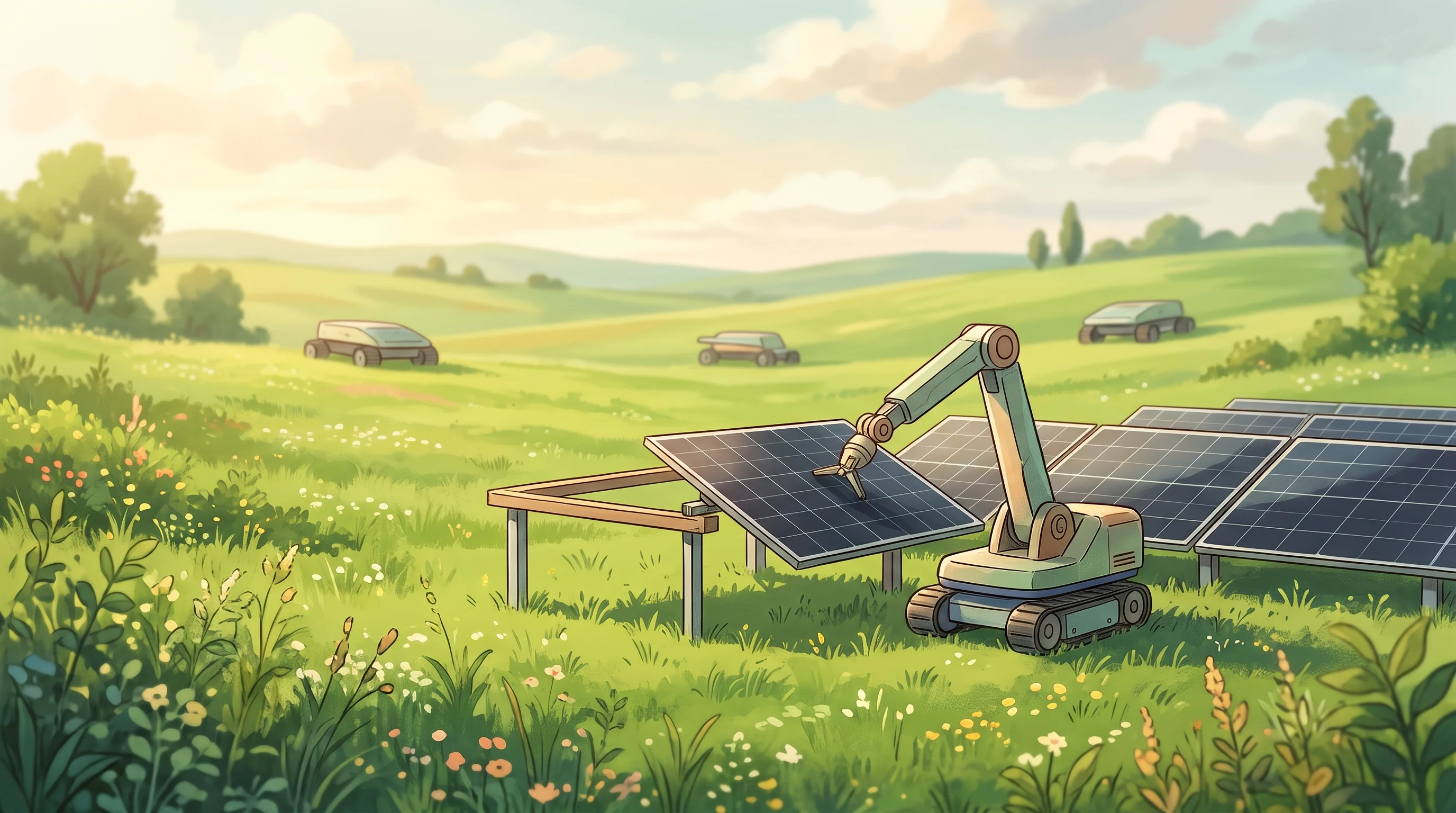
Cosmic is far from alone. AES-incubated Maximo announced on March 25, 2026 that it had installed 100 MW at AES's Bellefield complex using four robots in parallel. Terabase Energy said on March 19, 2026 that its Terafab V2 had finished field testing, claiming capacity above 20 MW per week per line.
Charge Robotics lists its Sunrise system at 850 to 1,000 modules a day with a 10-person crew. Rosendin and ULC Technologies announced in April 2025 a three-machine system that they said placed 350 to 400 modules per eight-hour shift with two workers. Built Robotics sells adjacent pile-driving equipment.
FTC Solar's July 8, 2026 Robo Day placed Cosmic alongside Aonics, BotCrew, Civ Robotics, Libra Robotics, Ozzies and RoboForce.
What comes next
SEED's July announcement anticipated a financing after YC, but nothing in the research shows that a priced round has closed.
For now, the case for Cosmic rests on a self-reported backlog, a handful of enthusiastic partners and a founder with a simple thesis. "Construction automation is the only way to scale solar and meet the growing demands of the industry," Emerick said in FTC Solar's July 8 announcement.


