

Julian Olschwang thinks the robotics industry has been missing something fundamental in its rush to train ever-smarter machines: the sense of touch.
His company, Hemlock, emerged from Y Combinator's Fall 2026 cohort with a wrist-worn device that captures the force each finger exerts during everyday tasks. The premise is simple enough—robots trained on video footage alone can see what humans do, but they can't feel how hard someone grips a screwdriver or how gently they need to handle an egg. Olschwang, working alone for now, is betting that muscle signals hold the key to closing that gap.
The device, which Hemlock calls The Bracelet, uses surface electromyography to read electrical activity in forearm muscles. A ring of dry electrodes sits at the wrist, picking up neuromuscular signals that correlate with finger force. The resulting data syncs frame-by-frame with egocentric video, creating what the company describes as contact annotations matched to visual footage.
It's a technical workaround for what Hemlock frames as a fundamental limitation in current robot training pipelines. Vision systems can reconstruct hand positions and track object geometry with impressive fidelity, but "force cannot be reconstructed downstream of kinematics," according to the company's Y Combinator profile. Translation: you can't infer how hard someone is squeezing something just by watching their hand move.
The challenge resonates across the robotics research community, though solutions vary widely. MIT researchers published work in March on an ultrasound wristband for decoding finger positions, noting it could eventually generate training data for dexterous robots. A September paper demonstrated a wrist-worn pressure array that recovers both hand pose and distributed contact forces. Other efforts include tactile gloves studded with sensors and benchmarks like FEEL, a force-enhanced learning dataset updated in August.
Some researchers are sidestepping wearables entirely. A method called RLHND, published in October, uses video foundation models to estimate hand pose and tactile signals from monocular footage without requiring users to wear anything. Macrodata Labs released a pipeline in August that converts egocentric video into 3D hand trajectories for robot supervision.
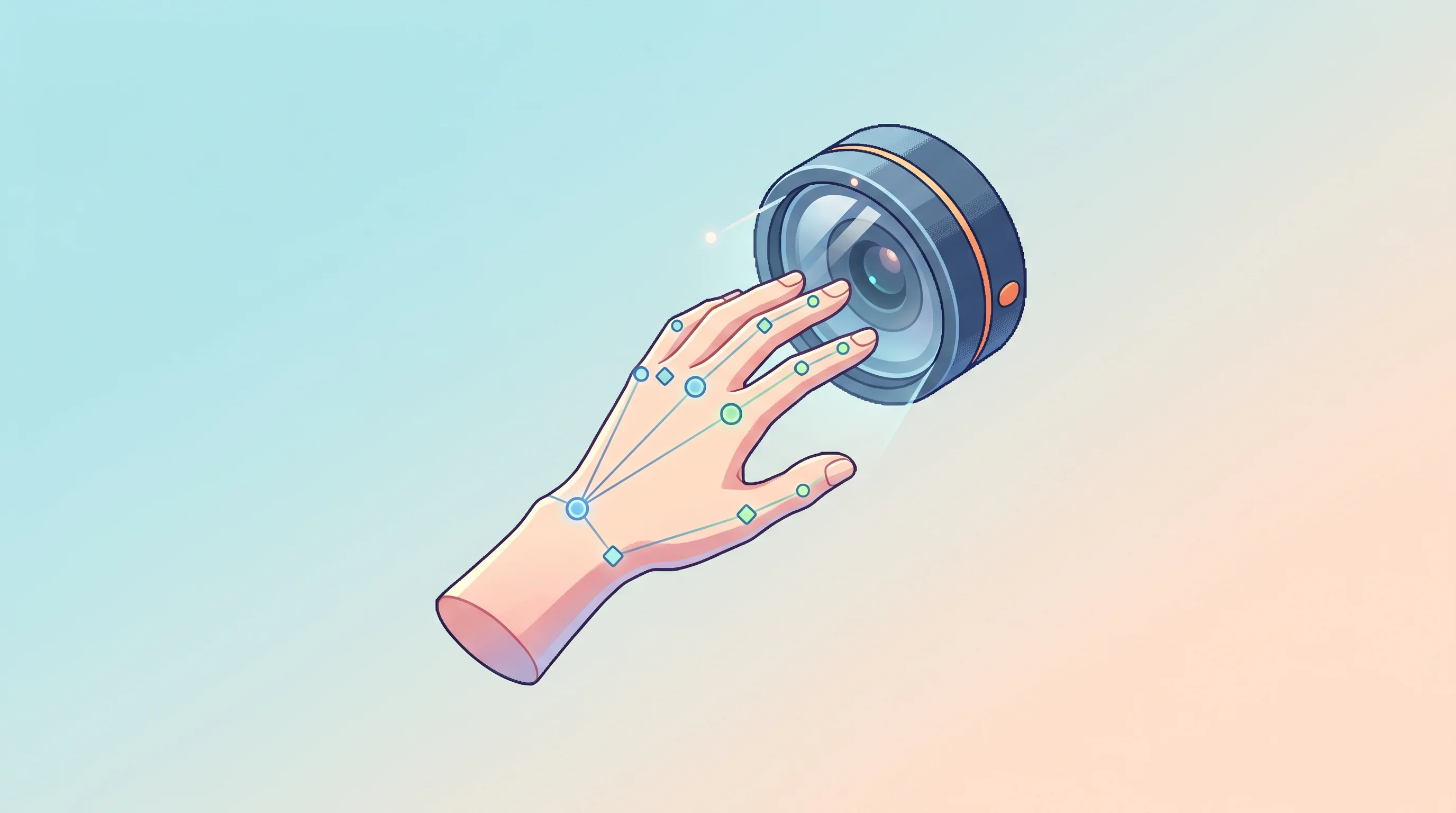
Hemlock's counter-argument hinges on biological primacy. Muscle signal, the company argues, is "the only non-invasive channel" that separates movement from force—capturing what it calls "the force behind human skill" at the source rather than inferring contact from pixels.
The company envisions deployment across assembly lines, warehouse packing stations, hospital supply rooms, and everyday manipulation scenarios like opening stubborn containers. Hemlock's website outlines two models: customers can collect data themselves using the device and upload it via API, or Hemlock will conduct on-site collection and deliver force-annotated datasets tailored to specific workflows.
Olschwang dropped out of Carnegie Mellon's electrical and computer engineering program before launching Hemlock in 2025. His background includes building generative adversarial networks for military robotic data at UCLA's Biomechatronics Lab. He was named a Davidson Fellow in July 2024 and received a Lockheed Martin STEM Scholarship in May 2024, according to his LinkedIn profile.
Y Combinator's jobs board lists Hemlock's team size as one, with no open positions as of mid-October. The company's website showed "Beta cohort is live" messaging in September, though current pages direct inquiries to a general contact form. No pricing appears publicly, and detailed specifications—sampling rates, electrode counts, battery life—remain undisclosed. Hemlock declined to share funding details beyond Y Combinator's standard batch investment.
The Fall 2026 batch is scheduled to present at Demo Day on December 2, when Olschwang will need to convince a room full of investors that muscle signals represent the missing ingredient in training robots that can manipulate the physical world with something approaching human dexterity. For now, at least, he's making that pitch as a team of one.


