

Preload, a three-person operation backed by Y Combinator, emerged from stealth in the fall of 2026 with hardware that its founders believe answers a question the robotics industry has been circling for months: How do you teach a machine to grip, press, and manipulate objects the way a person does when cameras can't see force?
The San Francisco startup, founded in 2026, has built what it calls a synchronized sensor stack. A head-mounted camera captures what the wearer sees. Pressure-sensing gloves record tactile feedback across fingers and palm. A forearm band measures muscle activation through electromyography. Together, the three streams generate data that vision-only training systems miss when trying to teach robots contact-rich tasks. The company raised a $125,000 seed round in September 2026, according to Dealroom.co, and is pitching the hardware as a turnkey data engine for AI labs and robotics companies building what the industry calls vision-language-action models.
The thesis reflects mounting evidence published over the past year. In August, researchers working on a project called EgoTac noted that "egocentric human videos widely used for robot learning rarely include tactile measurements." Two months later, another team released TouchScale, a dataset pairing 500 hours of human vision with dense bimanual tactile data aligned to egocentric RGB-D streams. Co-founder Surya Pandiaraju wrote in October that "physical AI has a scaling law of its own now, and its input is human data."
Whether that market crystallizes fast enough to support the hardware vendors now racing to capture it remains an open question.
When Vision Isn't Enough
Vision-language-action models have gotten good at inferring object identity and spatial relations from video. What they struggle with is grip strength, contact timing, the micro-adjustments humans make without conscious thought. A surgeon tying a suture applies varying pressure across fingertips. A warehouse picker modulates force when handling fragile packaging. Cameras miss those signals, or at best infer them incompletely.
Preload's answer is to record three synchronized streams. The output, according to the company, provides "sensorimotor context for physical AI." The founders bring backgrounds in medical devices and neural interfaces. Leo Li completed a PhD at Caltech and worked at Neuralink and Amazon. Pandiaraju holds a Johns Hopkins biomedical engineering doctorate and spent time at Paradromics, NeuroPace, iota Biosciences, and Sonera Magnetics. Runming Wang is a Johns Hopkins BME PhD candidate focused on EMG and motion tracking, per the company's Y Combinator profile. Their tagline: "Giving robots a nervous system."
It's a pitch that lands somewhere between ambitious and presumptuous, depending on how fast the robotics industry moves.
A Crowded Field
Preload is hardly alone in trying to close the multimodal data gap. Empirical Intelligence ships egocentric capture rigs with multi-camera synchronization, IMUs, and eight-hour battery life, exporting to the LeRobot format. Northstar Embodiment runs end-to-end capture operations that include head-mounted RGB, tactile-instrumented gloves, and quality-control playbooks. Kavana, a unit of Wearable Devices Ltd., pairs Mudra EMG bands with egocentric video and force sensors for robotic hand training. Contact.ci pitches tendon-based on-glove force sensing for teleoperation and training.
Component suppliers are also maturing. GelSight won a Phase II U.S. Air Force SBIR contract in March to miniaturize fingertip visuotactile sensors streaming 3D shape and force data. XELA Robotics released high-density 3D tactile sensor patches integrated with Allegro Hands. The Robotics Center's G1 Tactile Glove offers 162 pressure points per hand at 120 Hz, according to a June brochure. HaptX and StretchSense ship haptic gloves for teleoperation.
What distinguishes Preload, at least in its marketing, is the bundling: egocentric vision, tactile gloves, and EMG in a single synchronized package positioned explicitly for VLA training. Robot hand vendor Proception.ai listed Preload among its customers in mid-2026. Preload declined to disclose other customers or revenue, which is typical for a company this early but leaves the commercial traction unclear.
Industry Tailwinds
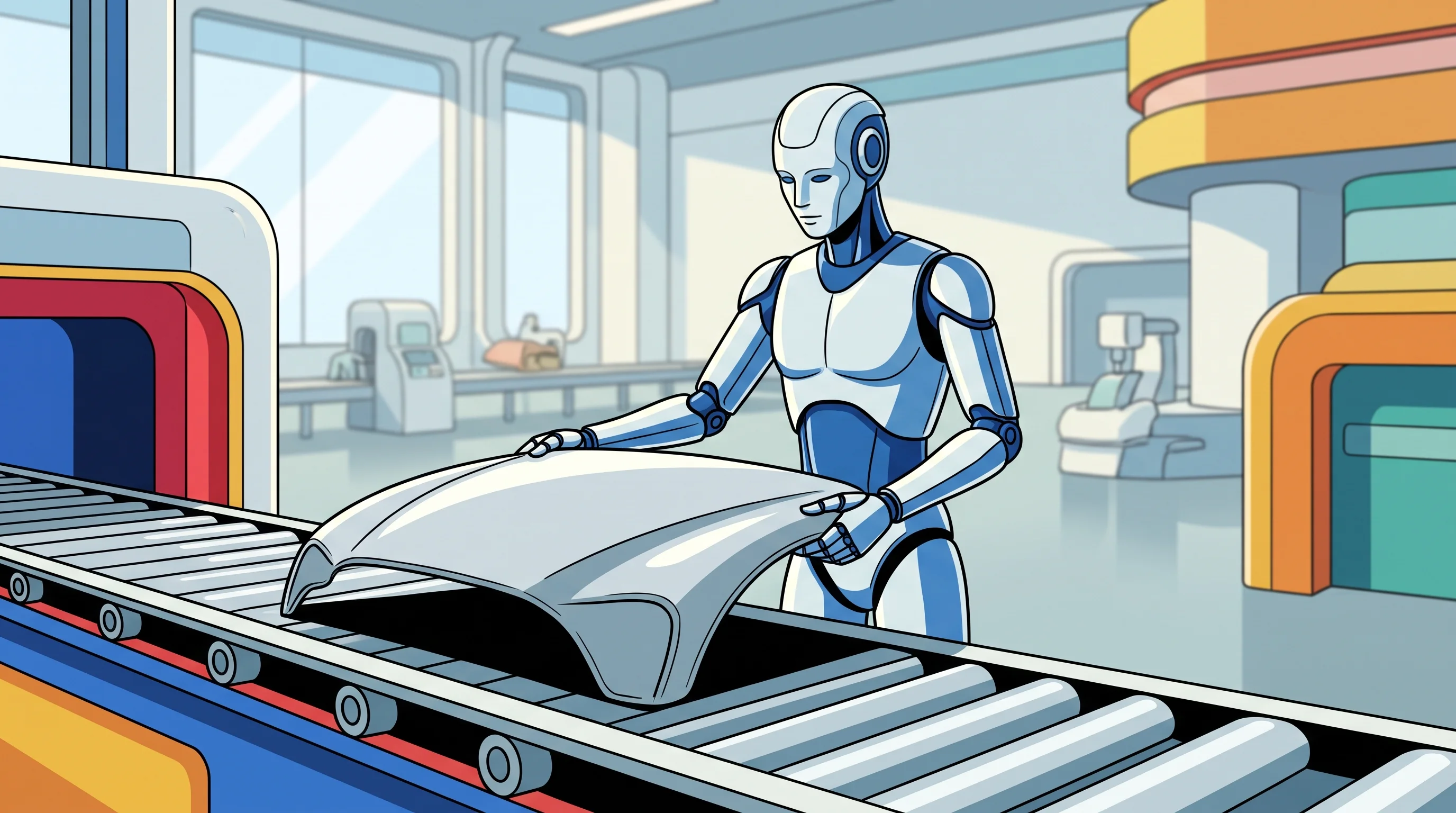
The data-engine narrative has found a receptive audience as industrial deployments accelerate. Figure AI deployed its F.03 humanoid at BMW's Spartanburg facility in June 2026 and announced access to up to 100,000 GPUs through a partnership with Nscale in September. Agility Robotics opened a Fremont facility in July to "accelerate physical AI development." NVIDIA CEO Jensen Huang said in May 2025 that "physical AI and robotics will bring about the next industrial revolution," a theme the company has repeated in keynotes since.
Academic datasets adding tactile and egocentric modalities proliferated this year. EgoDex provided 829 hours of egocentric dexterous manipulation at ICLR. The LeRobot ecosystem introduced a unified multimodal time-series format with plugin support for tactile and depth streams. Surveys published in the spring argued that progress depends on what one called "co-designed high-fidelity data engines" that integrate tactile with vision and language for contact-rich skills.
Intel research published in August found that six in ten leaders expect to operate robot fleets within five years, though strategy and infrastructure gaps remain. Bank of America Global Research forecast in March that annual humanoid shipments would climb from 20,000 units last year to 10 million by 2035, an 86 percent compound annual growth rate. McKinsey estimated in June that the robotics industry could reach the triple-digit billions by 2040.
Those projections assume robots can learn fast enough to justify deployment costs. That's the bet Preload is making.
The Privacy Layer
Wearable data capture faces mounting regulatory scrutiny. Illinois residents sued sidewalk delivery robot firms in October, alleging biometric capture without consent under the state's Biometric Information Privacy Act. The European Data Protection Board published a statement on October 13 warning that smart-glasses users can be data controllers and that recording individuals unknowingly raises significant privacy concerns. California treats "biometric information processed to identify a consumer" as sensitive personal information under the California Privacy Rights Act, which carries rights to limit processing.
The EU AI Act entered force in 2024, with transparency provisions effective in August and high-risk AI obligations phasing in through 2027 and 2028, according to the consolidated text published in July. Those rules require logging, data governance, and conformity assessments for certain AI in physical products.
Northstar Embodiment's methodology page includes privacy notes and quality-control playbooks. Empirical's export bridges support learning-ready formats with time-consistency and calibration metadata. Preload's website lists surgeons and industrial teams among target customers but does not detail consent flows or de-identification protocols. For a company capturing biometric data in medical and industrial settings, that omission may prove a gap worth closing.
The Long Game

Preload's $125,000 seed positions the company at the earliest stage of the physical-AI data market. Pandiaraju wrote in October that the team can "collect it end to end, at scale." That's a claim the founders will have to prove as AI labs and robotics OEMs race to train the next generation of contact-aware manipulation policies.
The hardware is ready, more or less. The customer base is still taking shape. Whether the market moves fast enough to support a wave of specialized data-capture vendors, or whether the largest robotics companies decide to build this capability in-house, will determine how crowded and lucrative this niche becomes. For now, Preload is betting that robots need to feel what humans feel. The industry seems inclined to agree, even if the path from thesis to traction remains uncertain.


