

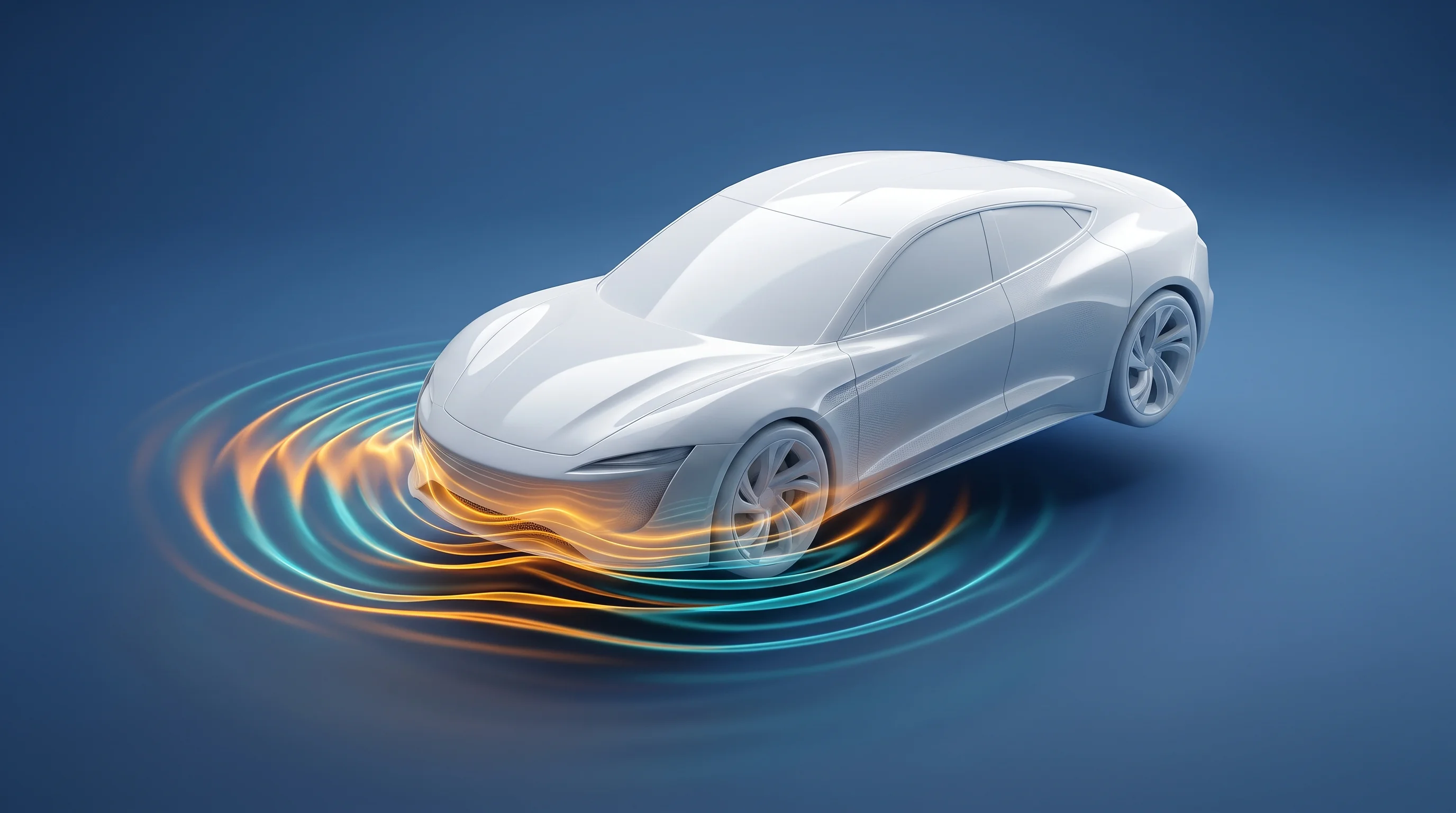
Vorelios, a Y Combinator-backed startup, says it has built an aerodynamic foundation model that predicts airflow far faster than computational fluid dynamics, the conventional simulation method engineers use to model how air moves around a wing or a car body. The company's own materials offer no verification of any speedup by outside parties.
Speed is the easiest thing for a physics AI company to demonstrate, and it happens to be the number investors notice. Accuracy on shapes a model has never encountered is far harder to prove, and that is where buyers in aerospace tend to press.
What Vorelios Says About Itself
The homepage describes an aerodynamic foundation model, meaning a large AI system trained on physics data to handle many airflow problems rather than one. A separately retrieved version of the same page frames a broader mission of autonomous engineering. Neither carries a publication date, so there is no way to tell which came first, and this article does not read the difference as a change of direction.
The company also publishes a results and methodology page, likewise undated. In the materials reviewed, Vorelios did not disclose how much funding it has raised, name a customer, or point to an independent benchmark of its speed claims.
Rivals With Bigger Checks
Competitors have raised considerably more. PhysicsX announced a $300 million Series C, according to a newsroom release dated June 8, 2026. Vinci announced a $250 million Series B at a $1.5 billion valuation, a round Reuters also reported. Neural Concept announced a $100 million round, and Luminary a $72 million Series B.
The established simulation vendors are not standing still. Synopsys launched Ansys 2026 R1 on March 11, 2026, with what it described as AI-powered products. Siemens released Simcenter summer 2026. NVIDIA expanded its PhysicsNeMo libraries in an announcement dated July 26, 2026.
Cost, Access and a Lot of Rhetoric
Founders in the field tend to describe the problem as one of price and access. "High-fidelity physics simulation has always been powerful, but it has also been slow, costly, and the preserve of a small group of specialists," said Robin Tuluie, founder and chairman of PhysicsX.
NVIDIA's Timothy Costa, vice president and general manager of computational engineering, cast it in larger terms. "Engineering has reached an inflection point. AI can now work with tools of physics, simulation and design," he said in the company's July announcement, according to an excerpt in the research.
Some of the language runs hotter still. BeyondMath CEO Alan Patterson said in a February 25, 2026 financing release: "This could be the ChatGPT moment for physics." The statement is more than six months old.
Narrower Bets
Luminary has gone after a specific task. On April 14, 2026, it announced SHIFT-Crash, which it called the first physics AI model for full-vehicle crash prediction. The company has also published a piece arguing that physics AI models must be anchored to reality.
Neural Concept emphasized the role of human engineers when it launched MCP Bridge on October 19, 2026. "The aim is to give engineers more time to explore design options, while they keep full control of the decisions that require engineering judgment," said Yoann Eulalie, R&I group leader at OPmobility.
In aerospace, LEAP 71 announced on December 11, 2025 that it had hot-fired two orbital-class methalox engines designed autonomously by its Noyron system. The Exploration Company licensed Noyron RP on March 24, 2026.
The Validation Gap
Academic research hints at the risk. A paper on arXiv titled "Do Physics Foundation Models Learn Generalizable Physics?" poses the question aerospace buyers are likely to ask. This article did not review the paper's findings and does not report them.
The European Union Aviation Safety Agency has published a concept paper on artificial intelligence. The research does not detail its contents, so what it means for Vorelios remains unclear.
What Comes Next
For Vorelios, the next test is evidence from outside. A named aerospace customer, a dated benchmark against a recognized CFD solver, or a peer-reviewed comparison would give engineering leaders something concrete to weigh. Until one appears, the company's speed claims remain unverified in the materials reviewed.
Its rivals have already committed capital and named partners to theirs. Mistral and Physical Superintelligence are also moving in, a sign that general-purpose AI labs are entering the same territory. Matthew Pines, CEO of Physical Superintelligence, said on September 1, 2026 that "PSI aims to industrialize the discovery of new physics."


