

GenRobot AI, a Beijing startup that sells human-movement capture gear and data pipelines for embodied AI, has raised a $100 million Series A+ round, TechNode CN reported on Nov. 2, 2026. The round closed in the third quarter.
The company says its quarterly "effective" data deliveries have grown from hundreds of thousands of hours to a million, a figure reported by the Beijing Municipal Sci-Tech Commission. The number lands at a moment when investors appear to be steering money toward the data that trains robots and away from the machines themselves.
A Crowded Field of Backers and Rivals
The investor list is long. It includes SAIC Motor, Baidu Group, Eastworlds of Malaysia, Shoucheng Holdings, Galaxy General Robotics (GALBOT), Guanghe Venture, SUNHELM, CICC Capital, CCB International and Huatai Zijin. TechNode CN, ChinaVenture and Eastmoney reported consistent lists.
GenRobot is hardly alone in this corner of the market. TechCrunch reported on Oct. 7, 2026 that Mecka AI raised a $60 million Series B led by Sequoia, with a focus on human motion for training humanoids. Innodata opened a motion-capture AI lab on Sept. 30, 2026. Scale AI announced a partnership with Universal Robots on March 16, 2026, and said on its blog that it delivered more than 150,000 hours of data and added 10 robotics customers in 2025.
"There's just no substitute for direct 3D motion capture," Frank Tanner, an Innodata vice president, said in the company's press release.
What GenRobot Sells
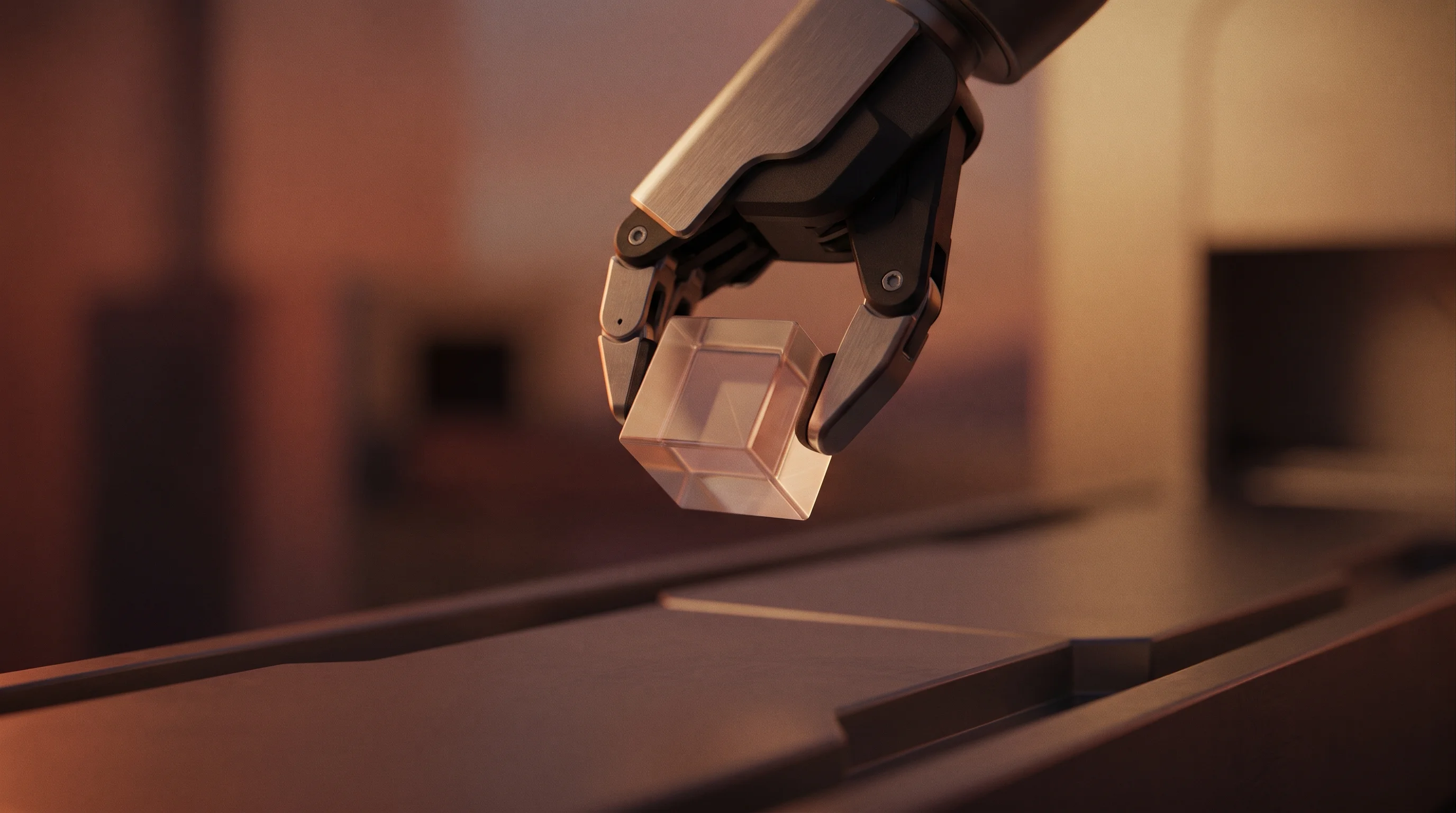
TechNode CN described three products. Gen DAS is capture hardware worn or held by people, sold in Ego (first-person), Fingers (bionic two-finger) and Gripper (bionic gripper) variants. Gen Matrix is a platform for data governance and cleaning. Gen ADP is an automated data production line.
According to a Gasgoo feature published Nov. 2, Gen Matrix aligns vision, 6D pose, depth, tactile, hand-tracking and full-body mesh data. The ADP pipelines draw on more than 3,000 contributors and more than 10,000 real scenes. The company also offers real-robot evaluation at fleet scale, and plans to unveil two new DAS 2.0 devices, Ego 2.0 and Dex 2.0, at CoRL 2026.
Citing the company's website, TechNode CN said GenRobot works with more than 30 domestic and international AI companies. The company says it is aiming for 10 million hours per quarter by 2027, roughly ten times its current pace.
Why Wearables, Not Robots
GenRobot collects data from people rather than from robots. Gasgoo's reporting said this approach raises throughput and lowers capital costs compared with real-robot teleoperation, in which a human remotely pilots a machine to record its movements.
Co-founder Zhu Yanming was blunt about the positioning in a May 12, 2026 interview with Sina Tech and Leiphone. "We are essentially a data solutions company," he said, according to a translation from the Chinese. Devices, he added, are the lowest layer of infrastructure and determine the modalities and base quality of the data. He also said the company relies on crowdsourcing, with data coming from real homes and scenes, which he called the ultimate path to large-scale, efficient collection of real data.
The problem the model targets is well documented. Stanford's AI Index 2026 notes that every piece of robot training data requires either a physical robot or high-fidelity simulation, and both are slow and expensive.
Founders and Funding History
CEO Chen Jianxing was previously senior algorithm director at Momenta, where he led the data flywheel production roadmap, according to EET-China. His co-founders include Zhu and Li Xinglong, a co-founder of Zhenji/Real Robot. Zhu said in May that the company had about 140 employees, more than 85% of them in research and development.
EET-China's recap of earlier backers runs as follows: Baidu Ventures led the seed round in August 2025, RoboSense led a seed-plus in October 2025, and Shunwei led an angel round in December 2025. Ant Group and Didi joined a Pre-A in June 2026, and Momenta led the Series A in August 2026. The outlet put cumulative disclosed funding at more than $200 million at that point, though its author cautioned that the sequence may contain discrepancies.
Competing Approaches to the Data Problem
Rivals are betting on different methods. LG Electronics is building a Robot Data Factory at its Yangjae R&D campus in Seoul, targeting 100,000 hours by the end of 2026 with synthetic augmentation through NVIDIA Cosmos. Tesla, according to its disclosures, plans to use thousands of Optimus robots for internal collection and self-play; on its Q3 2026 call, Elon Musk said the company needs to build on the order of 10,000 to 20,000 bots first. Figure AI announced a crowdsourced dataset initiative called Index on Aug. 25, 2026.
Open data is growing as well. GenRobot released Gen-HumanEgo on Sept. 23, 2026, with more than 1,800 hours of egocentric human skills. Apple's EgoDex, presented at ICLR 2026, contains 829 hours.
Demand Depends on Robots Reaching Production
All of this rests on robots actually reaching factories and homes, and forecasts diverge sharply. Bank of America Institute projects humanoid shipments rising from 20,000 units in 2025 to 10 million by 2035. Gartner said on Jan. 21, 2026 that fewer than 20 companies will scale humanoid robots to production in manufacturing and supply chain by 2028.
China's humanoid sector is sizable. Figures from MIIT and SCIO, cited by China's State Council Information Office, put shipments at about 14,400 units in 2025, with more than 140 manufacturers. The AP reported in June 2026 that the challenge is finding enough paying customers.
For GenRobot, the next test is hardware. The company said it will show Ego 2.0 and Dex 2.0 at CoRL 2026.


