

Reflect Orbital, the Hawthorne, California, startup that won FCC approval on July 9, 2026 for its first demonstration mirror satellite, plans a constellation of up to 50,000 satellites by 2035, according to Science News and Smithsonian Magazine. The license clears one hurdle. Astronomers, environmental groups and a fast-growing fleet of grid batteries now test whether "sunlight on demand" can pay for itself.
What the License Covers
The grant is for Earendil-1, a demo satellite carrying an 18-by-18-meter mirror, according to Astronomy magazine. It authorizes two years of operations at a target altitude of about 625 kilometers, under the call sign S00711.
The longer-term ambition is far larger. Reflect has said it wants about 4,000 satellites by the end of the decade and 50,000 by 2035, Science News reported Sept. 17. Space.com put the long-term aim at "50,000 or more." Research for this story turned up no credible source for a 57,000-satellite plan, and a 2025 RudeBaguette article that appeared to support one cited 57 satellites.
The company was founded in October 2021. CEO Ben Nowack is a former SpaceX intern and onetime Zipline employee, according to the research for this story, and co-founder Tristan Semmelhack holds CPO and CTO roles. Reflect announced a $6.5 million seed round led by Sequoia on Sept. 24, 2024, followed by a $20 million Series A led by Lux Capital on May 14, 2025. Shaun Maguire of Sequoia and Josh Wolfe of Lux sit on the board, per the company's FCC filing.
The Pitch, and the Arithmetic
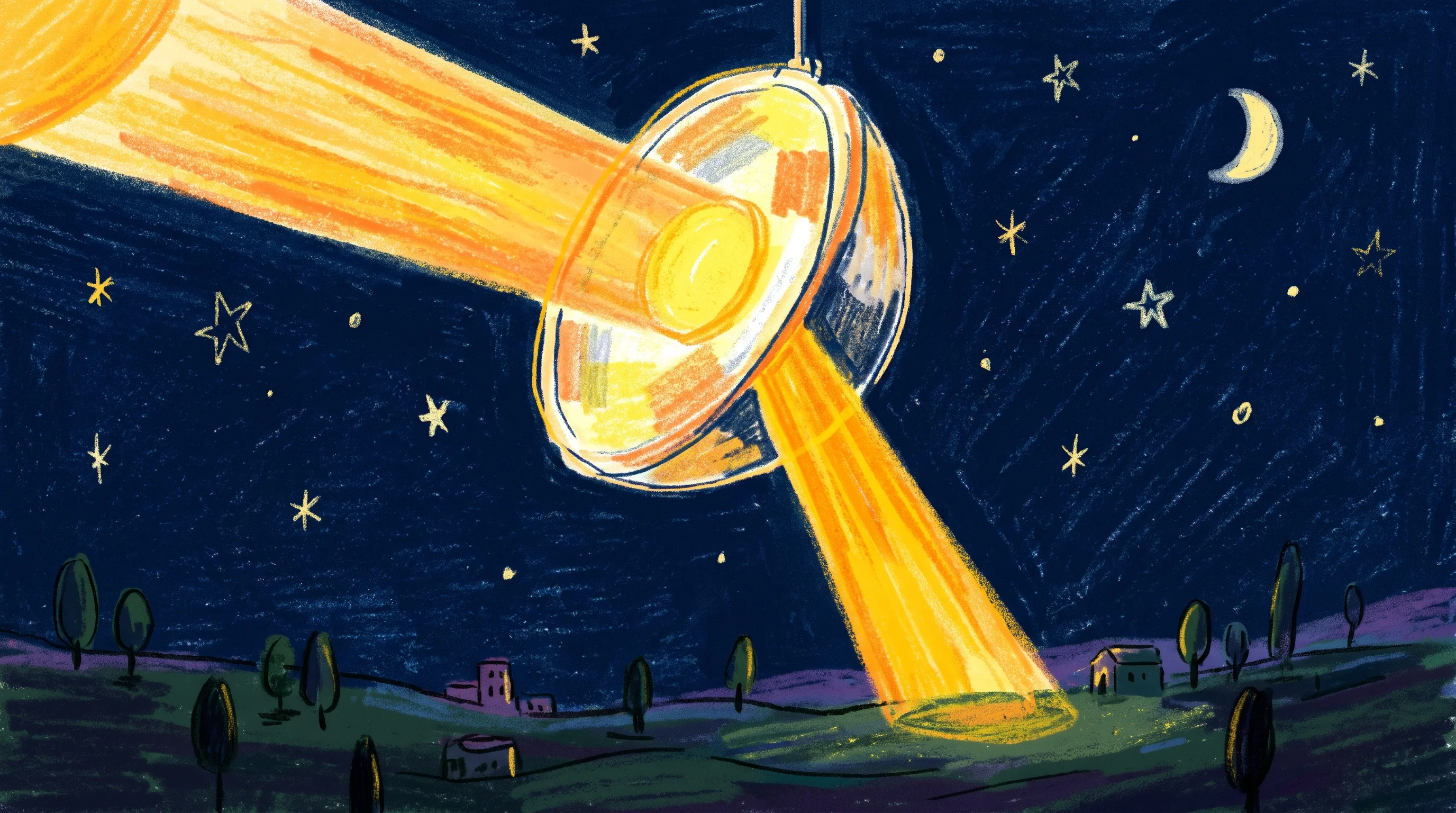
Reflect says its mirrors could extend solar output after dark and light disaster zones, search-and-rescue operations and events. Payload reported a "sunlight-as-a-service" figure of $5,000 per hour, which Sky & Telescope repeated as the company's pricing target.
Nowack told Payload on Aug. 14 that the public misreads the plan. "They kind of picture the whole Earth being lit up by our satellites, and that's not the case at all," he said. "We only need about 200 sites around the world to close our business model for the first several years."
The economics are chasing a moving target, though. California passed 21,112 MW of battery capacity as of August 2026, according to the California Energy Commission. CAISO, the state's grid operator, reported 3.423 TWh of renewable curtailment in 2024, 93% of it solar, per a June 2025 CPUC filing. Curtailment, meaning power that goes unused because the grid cannot absorb it, suggests solar is already abundant by day. That surplus is the problem batteries are built to solve.
An outside estimate points to a steeper cost. Astronomer Michael Brown told ABC News on July 19 that reaching "daylight" levels at a single site could cost $10 million to $20 million per hour, based on assumed mirror sizes and quantities. That is an external calculation, not company pricing.
Scale is a constraint of its own. A single mirror's footprint is about 5 kilometers wide, with roughly four minutes of dwell per pass, according to Science News, so continuous illumination would take many satellites. Nowack was candid with Payload about the funding gap: "We want to launch a full Falcon 9 as soon as possible… Potentially a couple in 2028… [we] don't have the money… But that's what we're shooting for."
Opposition Gathers

The American Astronomical Society filed a petition to deny on March 9, 2026. After the grant, it said it was "deeply concerned by the statement from the FCC that the deployment of a solar reflector is beyond the scope of the Commission's authority to regulate."
In August, Earthjustice filed an Application for Review on behalf of DarkSky International, PEER, Environment America and American Bird Conservancy. Ex Terra JSC reported on Oct. 14 that the Earthjustice challenge and one separate individual petition remain pending. The same day, the FCC extended Reflect's surety bond deadline to Jan. 5, 2027.
Science News cited modeling by ESO's Hainaut and a preprint by Bakos and colleagues suggesting a 50,000-satellite fleet could make even excellent dark-sky sites resemble suburban skies. The Bakos preprint, which has not been peer reviewed, suggests beams could be visible tens of kilometers away, with astronomy disruption reaching roughly 100 kilometers.
"It's an insane project," said Jonathan McDowell, honorary professor at Durham University. "There's a failure to understand that darkness is a good thing." Jan Hasselman, senior attorney at Earthjustice, told The Guardian on Oct. 26 that the 50,000-mirror proposal "would really end the night sky as we know it."
Reflect spokesperson Christopher Buscombe told Science News the company believes "exploring how new technologies can help the world forgo fossil fuels is a responsible application of the scientific process." The company has pledged opt-out zones near observatories and habitats. The AAS and dark-sky groups dispute whether that goes far enough.
Rivals and Precedent
Reflect is not alone in selling light from orbit, or power beamed from it. Virtus Solis signed a 20-year, 250 MW power purchase agreement with Brae Systems on Oct. 30, 2026, per PR Newswire, and has targeted a public wireless power transmission demo for March 2027.
The history is mixed. Caltech's SSPD-1 and the Naval Research Laboratory's SWELL both flew in 2023, and NRL said SWELL reached about 1.5 W at roughly 11% end-to-end efficiency. Decades earlier, Russia's Znamya-2 briefly reflected light in 1993, while Znamya-2.5 failed to deploy in 1999.
Regulation May Not Be the Brake
Regulation may not slow Reflect much. A D.C. Circuit ruling on July 12, 2024 upheld the FCC's categorical exclusion from NEPA environmental review for Starlink licensing. Davis Wright Tremaine and Via Satellite reported FCC actions in late September 2026 that narrowed environmental review further. The research found no U.S. standard limiting satellite optical brightness. The FCC's five-year deorbit rule, effective Aug. 9, 2024, applies to low Earth orbit systems.
Sky & Telescope reported on Nov. 2 that Reflect staged an October ground test in Lone Pine, California, using mobile spotlights to mimic beams, and that local and astronomy critics objected. The outlet also said full-size 54-meter mirrors could be far brighter than the full Moon within several kilometers.
What Comes Next
The next dates are concrete. Reflect's bond deadline is Jan. 5, 2027, and the Earthjustice challenge is unresolved. The company has not disclosed funding beyond its Series A, and Nowack has said it lacks the money for the Falcon 9 launches he wants.


